
"Goodnight Chesty Puller, Wherever You Are"
HOME - NEWS - TIMES - LISTINGS - SCHEDULE - SEGMENTS - ADVERTISING - CREW - PHOTOS


FRIDAY,
September 26th, 2003, AT 6:40 AM,
PT
"Good Night
Chesty Puller,
Wherever You Are!"
Text from various
sites on the web
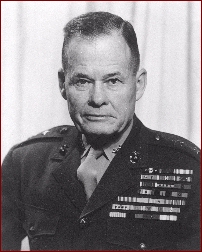
Those who are able to watch tonights edition of the IKF Kickboxing Show on CSS will hear Co-Host Brooks Mason (Right) say these words at the end of the show. The question many of you will ask is, "Who is Chesty Puller?" A common incantation in the tradition of the Marine Corps is to end one's day with the declaration, "Good night Chesty Puller, wherever you are!" But why?
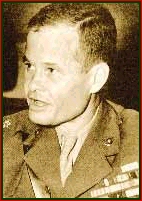
This is an often-used tribute of supreme respect to the late and legendary Lieutenant General Lewis B. "Chesty" Puller USMC. Chesty! Without a doubt was the most outspoken Marine, the most famous Marine, the Marine who really loved to fight, the most decorated Marine in the history of the Corps. He enlisted as a Private. Through incredible fortitude and tenacity he became a living legend. He shouted battle orders in a bellow and stalked battlefields as though impervious to enemy fire as he rose to the rank of Lieutenant General. He displayed an abiding love for the Magnificent Grunts, especially the junior enlisted men who did the majority of the sacrificing and dying, and utter contempt for all staff pogues of whatever rank. During his four wars, he was the only Marine to win the Navy Cross five times for heroism and gallantry in combat. The Marines' Marine!
He was a colorful veteran of the Korean War, four World War II campaigns, and expeditionary service in China, Nicaragua, and Haiti. A Marine officer and enlisted man for 37 years, General Puller served at sea or overseas for all but ten of those years, including a hitch as commander of the "Horse Marines" in China. Excluding medals from foreign governments, he won a total of 14 personal decorations in combat, plus a long list of campaign medals, unit citation ribbons and other awards. In addition to the Navy Crosses, the highest honor the Navy can bestow, he holds its Army equivalent, the Distinguished Service Cross.
No individual soldier in American history has embodied his service's ethos as has the Marine Corps' Chesty Puller. Puller went far beyond; he personally crafted the way the Marine Corps has defined itself since World War II by dint of his own personal example. The Marine tradition of having the officers eat last in common field messes in descending order of rank is a "Pullerism" as is the habit of encouraging officers to lead from the front. Puller was not the only senior Marine of World War II and Korea to put his command post on the front lines, but his stubborn habit of always doing so was unusual even among Marine leaders.
Chesty Puller's real value to the Marine Corps lies not in his unsurpassed record in combat. Rather it resides in the legacy of leadership by example that he set every day of his military life. His uncompromising approach to tough, realistic training and his dedication to taking care of his Marines without coddling them made him a beloved figure among the enlisted personnel of the Corps. That tradition still defines the Marine Corps approach to leadership. To this day, many Marine Corps drill instructors have their troops wish Chesty good night wherever he may be. His 14 personal decorations, excluding those from foreign governments, certainly are part of Puller's enduring lore, but perhaps the stories of his leadership, courage, honor, and fighting ability are his most important legacy. They serve as reminders and inspiration to generations of Marines that leading by example is the most important trait we can possess. Lewis B. "Chesty" Puller died in Hampton, Virginia, after a long illness at the age of 73.
Our good friend Brooks was a Marine but there is no "WAS" about it. As the saying goes, "Once a Marine always a Marine." He remembers Puller's accomplishments well. I know Brooks lives up to the leadership of Chesty and I would hope the rest of us in the IKF do the same in our everyday lives knowing that leading by example is the most important trait we can possess...
"Good
Night Chesty Puller, Wherever You Are"
Semper Fi
- Famous Puller Quotes
- "We're Surrounded... That Simplifies Our Problems"
- "All right, they're on our left, they're on our right, they're in front of us, they're behind us...they can't get away this time."
- "We're Surrounded... That Simplifies Our Problems"
- wikipedia.org - Chesty_Puller



HOME -
NEWS -
TIMES -
LISTINGS
-
SCHEDULE
- SEGMENTS
- ADVERTISING
- CREW -
PHOTOS
IKF HOME
-
NEWS -
EVENTS
- RANKINGS
- SANCTIONING
- JOINING
- RULES -
MERCHANDISE
- ISCF